
Is artificial intelligence replacing human thinking, or expanding what founders and marketers can achieve? The growing discussion around AI vs Human Brain is shaping how organizations evaluate technology and human capability.
That question sits at the center of every boardroom discussion in 2026. Venture capital decks mention AI in almost every category. Marketing teams rely on automation to scale campaigns. Product roadmaps now include machine learning as a core capability rather than an experiment.
Yet the real issue is not man versus machine. It is strategy. The debate around AI vs Human Brain is less about competition and more about how these systems complement each other in modern organizations.
For startup founders, the tension is practical. Should you automate customer support? Should your product roadmap depend on predictive models? Are you building defensible intellectual property, or renting algorithms from someone else?
For marketing leaders, the stakes are just as high. Can AI replace creative direction? Will performance marketing become fully algorithmic? Where does human insight still win? These questions are central to understanding the real implications of AI vs Human Brain in business strategy.
This article does not compare AI and the human brain for spectacle. It examines the differences that influence growth, innovation, and competitive positioning. You will see how machine learning systems process information, how human cognition creates meaning, and where each delivers leverage in business.
The founders who thrive in the next decade will not ask whether AI is smarter than people. They will ask a sharper question.
Where does artificial intelligence multiply human judgment, and where does it mislead it?
Let’s start by understanding how each system actually works in the evolving conversation around AI vs Human Brain.
How AI Works vs How the Human Brain Thinks
Artificial intelligence and the human brain both process information through networks. The similarity often ends there.
Modern AI systems rely on artificial neural networks. These models, inspired loosely by biological neurons, process vast volumes of data through weighted connections. In systems like those built by OpenAI, machine learning models identify statistical patterns across billions of examples. They do not “understand” content in a human sense. They calculate probabilities based on training data and produce the most likely next output.
The human brain operates through biological neural networks shaped by evolution, emotion, memory, and sensory input. Roughly 86 billion neurons interact in dynamic ways. Unlike AI models, human cognition integrates context, lived experience, social awareness, and moral judgment in real time.
This creates several critical differences for founders and marketers.
AI excels at computation. It processes massive datasets at speeds no human team could match. It recognizes patterns in customer behavior, pricing elasticity, and conversion pathways within seconds.
The brain excels at cognition. It interprets nuance, detects ambiguity, and generates meaning beyond surface patterns. A marketer can sense cultural shifts before they appear in analytics dashboards. A founder can spot strategic inflection points without a complete dataset.
AI produces deterministic outputs based on training data and model constraints. Human reasoning adapts when conditions change. When markets shift unexpectedly, people revise assumptions. Models require retraining.
Processing speed favors machines. Contextual understanding favors humans.
The strategic mistake is assuming one can replace the other. In reality, they solve different classes of problems.
Strengths of AI in Business Applications

Artificial intelligence delivers its greatest value in environments defined by scale, repetition, and data density.
For startups, this means AI becomes a force multiplier the moment customer data begins to accumulate. Machine learning systems can analyze millions of behavioral signals across channels, uncovering correlations that no analyst team could detect manually.
In marketing, the impact is immediate. Platforms such as Google and Meta rely on AI-driven auction systems to optimize ad delivery in real time. Campaign performance adjusts dynamically based on user behavior, device patterns, timing, and intent signals. What once required weeks of manual testing now occurs in milliseconds.
AI also transforms workflow automation. Lead scoring models prioritize prospects based on conversion probability. Email sequences adjust to engagement signals. Content recommendations personalize experiences at scale. The operational savings compound quickly.
Predictive modeling is another decisive advantage. Startups can forecast churn risk, customer lifetime value, and demand fluctuations with increasing accuracy. This enables tighter capital allocation and sharper growth bets.
Customer segmentation moves from broad demographic categories to micro-cohorts defined by behavior and intent. A/B testing becomes continuous experimentation rather than periodic review.
The common thread is scale. AI handles structured complexity with precision and speed. It thrives when historical data is abundant and patterns repeat.
However, data volume alone does not create strategic advantage. The companies that win are those that know which questions to ask before the model begins calculating.
Strengths of the Human Brain in Strategy and Creativity
Artificial intelligence processes patterns. The human brain creates meaning.
For founders and marketing leaders, that distinction matters more than processing speed. Strategy requires abstraction. It demands the ability to imagine conditions that do not yet exist, then align resources around that vision.
Creativity is not pattern recombination alone. It is the ability to connect unrelated domains, interpret cultural signals, and shape narratives that resonate emotionally. No dataset contains next year’s breakthrough idea. Those ideas emerge from intuition, experience, and cross-disciplinary thinking.
Emotional intelligence is another decisive advantage. The human brain reads tone, subtext, hesitation, and aspiration. A marketing campaign succeeds not because it optimizes clicks, but because it understands motivation. Persuasion depends on empathy, not probability scores.
Ethical judgment also remains human territory. AI systems reflect the data they were trained on. They do not evaluate consequences in a moral framework. Founders must decide where automation should stop. Marketing leaders must assess when personalization crosses into intrusion.
Brand storytelling further highlights this difference. A compelling narrative requires tension, identity, and cultural awareness. It interprets what a product means, not just what it does. Machines can draft copy. Humans define positioning.
In volatile markets, adaptability becomes critical. When conditions shift without precedent, historical data loses reliability. Human reasoning can pivot strategy before dashboards detect decline.
Computation drives efficiency. Cognition drives direction.
The startups that endure will recognize that intelligence is not only about processing data. It is about assigning value to it.
AI and Human Collaboration in Startups
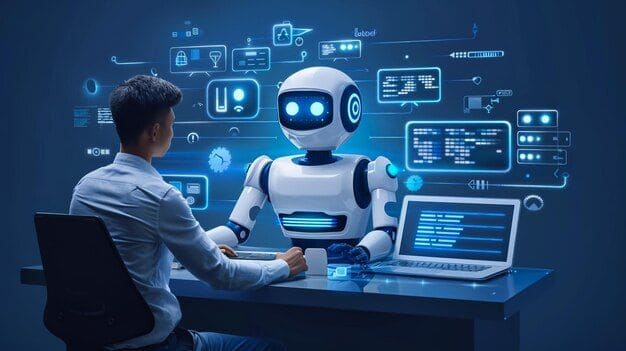
The most durable companies in 2026 do not frame AI vs Human Brain as a battle where one replaces the other. Instead, they design systems where artificial intelligence extends human judgment.
This approach is often described as augmented intelligence. Instead of delegating full control to algorithms, startups build human-in-the-loop workflows. Models generate insights, recommendations, or drafts. People validate, refine, and contextualize them. This collaboration reflects a more practical understanding of AI vs Human Brain, where each contributes different strengths.
In marketing teams, this integration is already visible. AI tools generate performance forecasts, audience clusters, and campaign variations. Human strategists decide which direction aligns with brand positioning and long-term equity. The system supports decisions. It does not make them in isolation, which is a central lesson in the AI vs Human Brain discussion.
Product development follows a similar structure. Predictive analytics surface feature usage trends. Customer support AI flags churn signals. Founders interpret whether those signals indicate pricing friction, product misalignment, or shifting market expectations. These examples highlight how AI vs Human Brain works best when analytical power and human interpretation operate together.
The difference between decision support and decision replacement is critical. When AI replaces judgment entirely, organizations lose strategic depth. When it informs judgment, it increases clarity and speed.
Workflow integration requires discipline. Teams must define where automation begins and where human review remains mandatory. Clear governance prevents blind reliance on model outputs.
Culturally, hybrid intelligence companies reward both technical literacy and strategic thinking. Engineers understand market implications. Marketers understand model limitations.
The competitive edge does not come from owning the most advanced algorithm. It comes from designing systems where computational power and human reasoning reinforce each other—an approach that reflects the evolving balance between AI vs Human Brain.
Risks, Limitations, and Misconceptions

Artificial intelligence creates leverage. It also introduces risk when misunderstood.
One of the most visible limitations is model hallucination. Large language models can generate confident responses that are factually incorrect. They predict likely sequences of words. They do not verify truth unless connected to validated systems. For founders, this becomes dangerous when AI outputs influence investor communication, product claims, or compliance documentation without human review.
Bias presents another structural issue. Models inherit patterns from historical data. If past data reflects inequality or skewed sampling, predictions will replicate those distortions. Automated hiring filters, pricing algorithms, or targeting systems can amplify bias at scale if governance is weak.
Overreliance on automation is equally risky. When teams outsource too much thinking to dashboards and predictive models, strategic intuition weakens. Data should inform judgment, not replace it.
Data privacy and governance concerns continue to intensify. Customer trust erodes quickly if AI systems misuse personal information or lack transparency. Regulatory frameworks are tightening across major markets. Compliance is now a strategic requirement, not a legal afterthought.
Another misconception involves artificial general intelligence. Narrow AI systems excel at defined tasks such as classification, prediction, or content generation. They do not possess consciousness, self-awareness, or cross-domain reasoning equivalent to human cognition.
Confusing narrow AI with human intelligence leads to flawed strategy. Founders who assume machines can independently manage complex uncertainty often discover the limits too late.
Understanding these constraints is not pessimism. It is strategic realism.
What This Means for Startup Strategy and Marketing Leadership

The AI era does not eliminate competitive advantage. It changes where advantage lives.
When advanced models become widely accessible through platforms such as OpenAI and Google, raw access to algorithms no longer differentiates a startup. Execution does. The edge shifts from owning technology to applying it with strategic clarity.
For founders, this means building systems where AI improves operational efficiency while human insight defines direction. Competitive advantage emerges from proprietary data, domain expertise, and sharp positioning. Models trained on public data create parity. Insight built on lived customer understanding creates separation.
Authority in marketing now depends on combining analytical precision with narrative depth. AI can optimize targeting and forecast performance. It cannot define a brand’s belief system or long-term identity. Leaders who integrate data fluency with persuasive storytelling will command attention in crowded markets.
Hiring strategy also evolves. Technical talent remains critical, yet strategic thinkers become equally valuable. The strongest teams include engineers who understand commercial tradeoffs and marketers who grasp model limitations. Hybrid literacy becomes a leadership requirement.
Messaging must reflect this balance. Startups should avoid claiming that AI replaces expertise. Instead, positioning should emphasize human judgment enhanced by intelligent systems. Customers trust competence. They do not trust blind automation.
The founders who build durable companies in 2026 will not compete on access to AI alone. They will compete on how intelligently they deploy it.
Conclusion: Intelligence Is a Strategic Choice
The debate between AI vs Human Brain misses the real opportunity.
AI dominates when scale, speed, and pattern detection matter. It analyzes vast datasets, optimizes campaigns in real time, and reduces operational friction. In growth environments defined by repetition and measurable inputs, machine learning delivers measurable gains. This is one of the core realities shaping the discussion around AI vs Human Brain in modern organizations.
The human brain dominates when direction, judgment, and meaning are required. Strategy demands abstraction. Brand positioning demands narrative. Ethical decisions demand accountability. These capabilities do not emerge from probability calculations, which is why the conversation around AI vs Human Brain continues to emphasize human cognitive strengths.
For startup founders and marketing leaders, the advantage lies in integration.
Artificial intelligence should strengthen decision quality, not replace it. Human cognition should guide where automation is applied and where restraint is necessary. When these systems reinforce each other, organizations gain clarity without losing adaptability. The real lesson from the AI vs Human Brain debate is that collaboration creates stronger outcomes than competition.
The widespread adoption of AI does not erase differentiation. It shifts differentiation toward proprietary insight, disciplined execution, and customer understanding. Access to algorithms is becoming universal. Strategic intelligence remains scarce.
If you want to compete effectively in 2026, conduct a direct audit of your current AI usage.
Where are you using automation without oversight?
Where are you underusing data that could sharpen decisions?
Where does human insight create value that no model can replicate?
Refine those boundaries. Strengthen the collaboration between machine computation and human reasoning.
That balance will define the next generation of market leaders in the evolving conversation around AI vs Human Brain.