


Search behavior is no longer confined to traditional search engines.
Today, buyers ask AI systems direct questions and receive synthesized answers instead of scrolling through ten links. Platforms powered by OpenAI, generative features introduced by Google, and a growing ecosystem of AI assistants now influence how decisions are made across B2B and consumer markets alike.
This shift creates a structural gap in most marketing analytics.
Teams still track keyword rankings, backlinks, and organic traffic. Yet they rarely measure whether their brand appears inside AI-generated responses. When a generative engine cites your competitor instead of you, the loss is invisible in traditional dashboards. Rankings may look healthy while AI systems quietly shape buyer perception elsewhere.
AI Visibility Tools: Track Generative Search Presence are designed to close that gap.
These platforms reveal how often your brand is mentioned, cited, or included in AI answers. They surface which prompts trigger inclusion, which competitors dominate responses, and how generative engines interpret your authority. In an environment where AI answers increasingly precede website visits, this data becomes a strategic asset.
In this guide, we examine the best AI Visibility Tools: Track Generative Search Presence in 2026 and explain how to evaluate them with precision. You will learn how to monitor AI search presence, benchmark competitors, and align visibility measurement with a modern SEO and growth strategy.
If organic search defined the last decade of digital marketing, AI Visibility Tools: Track Generative Search Presence will help define the next era of discoverability.
What Are AI Visibility Insights and Why They Matter
AI visibility insights refer to the measurement of how often and how prominently your brand appears inside AI-generated responses.
Instead of tracking where your website ranks on a search engine results page, AI visibility tracking focuses on whether generative systems include your brand in synthesized answers. This includes citations, brand mentions, source links, entity references, and contextual inclusion within AI summaries.
Traditional SEO tracking answers one question:
Where do we rank?
AI visibility tracking answers a different one:
Are we influencing the answer itself?
That distinction is critical.
When users rely on generative engines for research, product comparisons, and strategic decisions, they often accept the first synthesized answer as authoritative. If your brand is referenced in that response, you gain credibility and attention before a click even happens. If it is excluded, your ranking position becomes less relevant.
Generative search is also changing brand discoverability. AI systems aggregate information from multiple sources and prioritize entities with strong authority signals. This includes structured data, trusted citations, consistent brand positioning, and contextual relevance across the web.
For startups and growth teams, this means:
- Measuring citation frequency across AI platforms
- Tracking prompt-level inclusion
- Monitoring how competitors appear in generative responses
Trust signals now extend beyond backlinks and domain authority. AI systems evaluate consistency, expertise, and corroboration across multiple sources. Brands that demonstrate strong E-E-A-T signals are more likely to be referenced in AI answers.
In short, AI visibility insights help you understand whether your brand participates in the new layer of search influence. As generative systems continue to mediate discovery, measuring this layer is no longer optional. It is a strategic requirement.
Key Features to Look for in AI Visibility Tools
Not all AI visibility platforms measure the same signals. Some focus on brand mentions. Others analyze citation patterns, prompt performance, or competitive presence across generative engines. Choosing the right tool requires clarity about what you want to measure.
The first capability to prioritize is AI citation tracking across generative platforms. A strong platform should monitor how often your domain is referenced in responses generated by systems influenced by OpenAI models, generative features within Google search experiences, and other AI-driven discovery environments. Visibility without citation data lacks context. You need to know not just whether you appear, but how and where you are referenced.
Brand mention monitoring is equally important. AI systems often reference entities without linking directly. Tracking unlinked mentions helps you understand how models interpret your authority and positioning.
Prompt-level performance tracking is another critical feature. AI results change based on phrasing. A mature tool should show which prompts trigger inclusion, how response framing differs, and how consistently your brand appears across variations of the same intent.
Competitive benchmarking completes the picture. Visibility is relative. If your competitors are cited more frequently, more prominently, or in higher-trust contexts, you need that intelligence to adjust your strategy.
Data export and integration capabilities also matter. AI visibility data should connect with your existing SEO stack, CRM, and analytics systems. Without integration, insights remain siloed.
Finally, evaluate transparency. Reliable platforms disclose their methodology, sampling logic, and update frequency. In an environment where AI systems evolve rapidly, clarity around data accuracy is essential for decision-making.
Selecting a tool without these features may give you surface metrics. Selecting one with them gives you strategic leverage.
Best Tools for AI Visibility Insights
The market for AI visibility tracking is expanding, but not every platform offers the same depth of insight. The tools below represent leading approaches to measuring brand inclusion, citation frequency, and competitive presence across generative search environments in 2026.
Profound AI
Profound AI positions itself as an enterprise-grade AI search analytics platform. It focuses on large-scale prompt monitoring and structured reporting across multiple generative systems.
Its strength lies in depth. Teams can track citation frequency, benchmark competitors, and analyze visibility trends across defined prompt clusters. Executive dashboards make it suitable for leadership reporting.
The trade-off is complexity and cost. Profound AI is best suited for mid-market and enterprise organizations treating AI visibility as a strategic growth channel rather than an experiment.
Pricing is custom and tailored to enterprise needs.
Peec AI
Peec AI emphasizes usability and actionable reporting. It tracks brand mentions and citation inclusion across generative environments influenced by systems developed by OpenAI and generative features introduced by Google.
Its interface is accessible for growth teams that need clarity without enterprise-level implementation overhead. Prompt-level analysis helps identify where inclusion opportunities exist.
Coverage may not be as extensive as enterprise platforms, but for startups and performance-focused teams, it provides strong operational value.
Pricing follows a SaaS subscription model.
AthenaHQ
AthenaHQ integrates AI visibility monitoring with content optimization workflows. Rather than isolating measurement, it connects prompt tracking to editorial strategy.
Teams can identify which queries drive inclusion, assess competitor references, and translate insights into content updates. This alignment supports organizations with mature SEO operations.
AthenaHQ works best for SaaS companies and content-led growth teams seeking operational integration rather than standalone reporting.
Pricing is tier-based and scales with usage.
Goodie AI
Goodie AI approaches AI visibility from a narrative perspective. In addition to tracking mentions, it evaluates how brands are positioned inside AI-generated responses.
This qualitative layer helps communications and brand teams understand contextual framing. It highlights tone, comparative language, and authority perception within responses.
While quantitative benchmarking features continue to develop, its narrative analysis makes it useful for PR-driven organizations.
Pricing is subscription-based.
Otterly AI
Otterly AI is one of the earlier platforms focused on generative search monitoring. It provides straightforward brand mention tracking and comparative reporting.
Its simplicity makes it accessible for teams beginning to explore AI visibility. However, advanced benchmarking and deep prompt segmentation may be limited compared to newer enterprise platforms.
Otterly AI is suitable for lean marketing teams seeking early insight without heavy implementation requirements.
AlsoAsked for Query Expansion
AlsoAsked is not an AI visibility tracker in the strict sense, but it plays an important supporting role.
It maps question clusters and intent pathways, helping teams identify how prompts are structured across discovery journeys. These insights inform which queries should be monitored inside AI systems.
For SEO specialists refining entity coverage and content expansion, it strengthens the strategic foundation of AI visibility tracking.
Semrush AI Visibility Features
Semrush has introduced AI visibility tracking within its broader SEO suite. This allows teams to compare generative search presence alongside traditional keyword rankings and competitive metrics.
The advantage lies in ecosystem integration. Teams already using Semrush can expand reporting without adding a separate tool.
However, dedicated AI visibility platforms may offer deeper prompt analysis and citation segmentation.
Semrush works well for established SEO teams expanding into AI-driven measurement.
How to Build an AI Visibility Strategy
AI visibility tracking only becomes valuable when it informs action. A structured approach ensures that measurement translates into influence.
Begin by defining where visibility matters most. Map the commercial and decision-driven prompts your buyers are likely to use inside generative systems. Focus on comparison queries, solution discovery questions, and industry-level strategic searches. Tools such as AlsoAsked can help uncover intent pathways that shape how AI answers are structured. This step establishes your measurement universe.
Next, establish a consistent tracking model. Monitor how frequently your brand appears across defined prompt clusters. Evaluate whether it is cited directly, mentioned contextually, or excluded entirely. Platforms like Semrush and dedicated AI visibility tools can centralize this data. The objective is not a single snapshot, but trend analysis over time.
Once measurement is in place, strengthen entity clarity. AI systems recognize structured entities, not isolated pages. Align brand descriptions, leadership bios, product narratives, and structured data markup to reinforce consistency across the web. Consistent entity signals increase inclusion probability.
Authority reinforcement is equally important. Secure credible third-party references, maintain accurate structured schema, and ensure subject-matter expertise is clearly attributed. Generative systems synthesize consensus. Brands that demonstrate corroborated expertise appear more reliably.
Finally, integrate insights into ongoing content and PR strategy. Test adjustments, monitor shifts, and refine positioning. AI visibility is not a campaign. It is an evolving layer of search influence that requires sustained strategic attention.
Common Mistakes When Tracking AI Visibility
Many organizations approach AI visibility with an SEO mindset that no longer fits the environment.
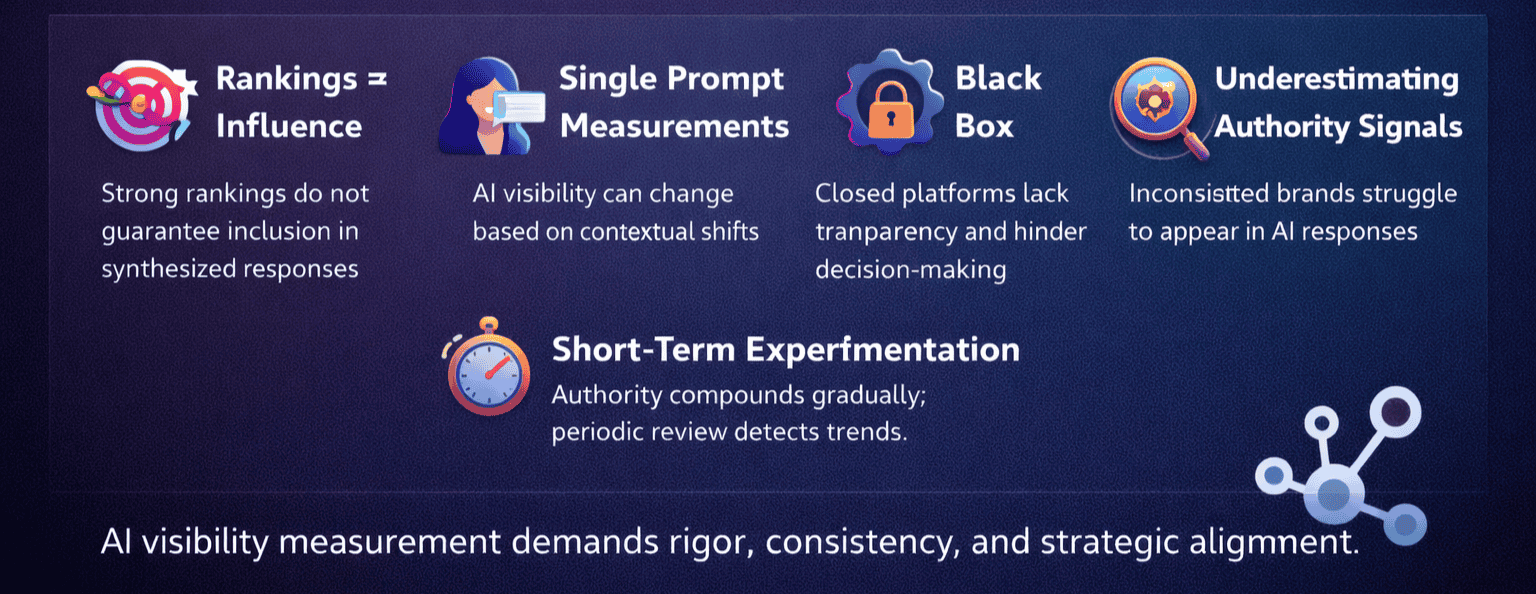
The most frequent error is equating rankings with influence. Traditional search metrics show where a page appears. AI systems decide which sources shape the answer. Those are different outcomes. A strong ranking position does not guarantee inclusion in a synthesized response.
Another mistake is measuring a single prompt and assuming stability. Generative systems interpret context dynamically. A small change in wording can alter which brands are referenced. Without tracking clusters of related prompts, visibility data becomes fragmented and misleading.
Some teams also treat AI visibility tools as black boxes. If a platform does not disclose sampling logic, monitored systems, and refresh cadence, its insights lack credibility. Decision-making requires transparency, not surface metrics.
Authority signals are often underestimated. AI engines prioritize corroborated expertise. Brands with inconsistent positioning, weak third-party references, or limited entity clarity struggle to appear consistently in responses. Optimizing content without strengthening authority rarely improves inclusion.
Finally, short-term experimentation limits impact. AI visibility shifts gradually as authority compounds across sources. Organizations that review data sporadically fail to detect meaningful trends.
AI visibility measurement demands rigor, consistency, and strategic alignment. Without those elements, the data may look sophisticated while offering little operational value.
Conclusion
AI-driven discovery is no longer experimental. It is shaping how buyers evaluate products, compare solutions, and form first impressions of brands.
Traditional SEO metrics still matter. Rankings, traffic, and backlinks remain foundational. Yet they no longer tell the full story. If generative systems synthesize answers before users visit a website, influence shifts upstream. Measuring AI visibility reveals whether your brand participates in that synthesis.
The best tools for AI visibility insights provide clarity on citation frequency, prompt-level inclusion, competitive presence, and authority positioning. Used correctly, they transform generative search from an unknown variable into a measurable growth channel.
Early adopters gain an advantage. As AI systems refine how they prioritize entities and trusted sources, brands with consistent authority signals and structured data alignment will appear more reliably. Those who delay measurement risk discovering visibility gaps after competitors have already established dominance.
The next step is practical.
Audit your brand across high-value AI prompts. Test at least one dedicated AI visibility platform. Compare inclusion trends against competitors. Then align your content, PR, and authority strategy with the insights you uncover.
Search optimization defined the last era of digital growth. AI Visibility Tools: Track Generative Search Presence are becoming essential for organizations that want to understand how generative systems represent their brand and influence buyer perception before the market fully adjusts.