

The Shift From Traditional SEO to AI-Driven Search
Search is no longer a list of ten blue links.
For more than two decades, search engine optimization revolved around keywords, backlinks, and technical structure. Marketers focused on ranking web pages. Today, AI systems generate answers, summarize sources, and hold conversations with users. Visibility no longer depends only on ranking positions. It depends on whether AI models choose your content as a trusted source.
This shift is driven by large language models, conversational interfaces, and generative search experiences. Instead of typing fragmented keywords, users now ask complete questions. They expect synthesized answers, follow-up suggestions, and contextual understanding. AI-driven search interprets intent, evaluates authority, and pulls insights from multiple sources before presenting a response.
For digital marketers and startup founders, this changes the rules.
Traditional SEO tactics such as keyword density and exact-match anchors are losing influence. Signals like topical authority, entity relationships, user engagement, and demonstrated expertise are becoming central. Search engines are evolving into answer engines, and ranking factors are evolving with them.
Understanding The Future of AI Search Ranking Factors is not optional. Brands that adapt early will earn visibility inside AI-generated summaries and conversational results. Those that rely on outdated optimization methods risk disappearing from high-intent queries.
This article breaks down The Future of AI Search Ranking Factors and what you must prepare for in 2026. If your growth strategy depends on organic discovery, the time to rethink your approach is now.
From Keywords to Context and Intent in The Future of AI Search Ranking Factors

For years, SEO was driven by keyword placement.
Marketers calculated density, inserted exact matches, and optimized headings around specific phrases. That approach worked because search engines matched strings of text. AI search does not operate that way.
Modern systems interpret meaning.
Instead of focusing on isolated keywords, AI models analyze context, entities, relationships, and user intent. They examine how concepts connect within a topic. This is the foundation of semantic search and entity-based indexing.
When someone searches “best CRM for early-stage SaaS,” the system does not only scan for that exact phrase. It interprets intent. The user likely wants comparisons, pricing insights, scalability considerations, and integration capabilities. Content that addresses the broader decision context performs better than content that repeats the keyword.
Keyword density is no longer a primary signal. Relevance now depends on how comprehensively a topic is covered and how clearly the content aligns with search intent.
Large language models process queries as conversations. They evaluate:
- What problem is the user trying to solve?
- What level of expertise does the user demonstrate?
- What follow-up questions are likely to appear?
To create context-rich content, structure your pages around problems, not phrases. Define core entities clearly. Explain relationships between concepts. Anticipate related questions within the same article.
Instead of asking, “Did I include the keyword enough times?” ask, “Did I fully answer the intent behind this query?”
In AI-driven search, depth replaces repetition. Precision replaces stuffing. Context becomes the new optimization layer.
E-E-A-T in an AI Ranking Environment
AI search systems do not rank pages the way traditional algorithms did. They evaluate sources.
As generative engines synthesize answers, they prioritize credibility signals that reduce risk. That is where E-E-A-T becomes central. Experience, Expertise, Authoritativeness, and Trustworthiness are no longer abstract quality guidelines. They function as selection criteria for AI-generated responses.
When an AI model summarizes content, it asks implicit questions:
Is this source reliable?
Is this written by someone with direct experience?
Is this brand recognized within its topic?
If the answer is unclear, your content may not be cited, even if it ranks.
Experience now carries particular weight. First-hand insights, case studies, original data, and transparent methodology distinguish your content from generic summaries. AI systems detect patterns. Content that repeats surface-level explanations without adding depth is less likely to be referenced.
Expertise is demonstrated through specificity. Detailed analysis, structured reasoning, and clear definitions signal subject mastery. Authoritativeness is reinforced by mentions, backlinks, and citations from trusted domains. Trustworthiness emerges from transparent sourcing, clear author attribution, and consistent topical focus.
For startups starting from zero authority, the path is strategic consistency. Publish tightly focused content within one niche. Showcase founder insights. Cite reputable sources. Develop detailed author bios that clarify credentials and real-world experience.
AI-driven search rewards entities that demonstrate depth, not volume. Producing fifty shallow articles will not outperform ten rigorous, experience-backed resources.
In 2026, E-E-A-T will not simply support rankings. It will determine whether your content becomes part of the answer layer itself.
User Behavior and Engagement as Core Signals

AI search systems do not rely only on content analysis. They learn from behavior.
When users interact with search results, they generate feedback signals. These signals help AI systems refine which sources deserve visibility inside generated answers and conversational summaries.
Dwell time, interaction depth, and task completion now carry strategic weight.
If a user clicks your page, reads thoroughly, scrolls, interacts, and does not return to the search results immediately, the system interprets that as satisfaction. If users repeatedly reformulate queries after visiting your page, it suggests incomplete alignment with intent.
AI models improve through feedback loops. They analyze aggregated engagement patterns to determine which sources consistently resolve queries. Over time, this influences which domains are surfaced, summarized, or cited.
This shifts optimization away from manipulation and toward clarity.
Content designed for engagement does not rely on tricks. It focuses on structural efficiency. Clear headings. Logical progression. Concise explanations. Strong internal linking that guides users toward related answers.
Reducing cognitive friction increases retention. Long introductions, vague explanations, and buried insights reduce interaction depth. Readers disengage when they cannot quickly find relevance.
For marketers and startups, this means designing content around completion. What action should the user take after reading? What follow-up question will naturally arise? Does your structure anticipate it?
AI search rewards pages that resolve intent cleanly. The longer users remain engaged and the fewer corrective searches they perform, the stronger the behavioral signal.
In 2026, engagement metrics will not be secondary indicators. They will shape which brands are selected as reliable sources in AI-generated search results.
Structured Data, Entities, and Knowledge Graph Optimization

AI search systems rely on structured understanding, not just readable text.
Structured data helps machines interpret your content with precision. Schema markup clarifies what a page represents, who authored it, what entities are mentioned, and how those entities relate to one another. This reduces ambiguity and increases eligibility for enhanced search features.
In AI-driven environments, entity clarity matters more than keyword repetition.
An entity is a clearly defined concept such as a company, person, product, or technology. Search engines map these entities into knowledge graphs, where relationships between topics are stored and evaluated. When your content consistently connects related entities within a defined niche, it strengthens topical signals.
For example, a startup publishing about AI search should repeatedly connect related concepts such as semantic search, large language models, knowledge graphs, and search intent. Over time, this builds entity association depth.
Schema markup supports this process by explicitly labeling:
- Articles
- Authors
- Organizations
- FAQs
- Products
- Reviews
Proper implementation improves discoverability within AI summaries and rich results. It also increases trust signals through transparent authorship and structured references.
Beyond schema, internal linking architecture plays a strategic role. Content hubs that cluster related topics help AI systems understand topical authority. When cornerstone guides link to detailed subtopics, and those subtopics link back, the structure reinforces subject expertise.
AI discoverability depends on clarity. Clear entities. Clear relationships. Clear hierarchy.
In 2026, brands that treat structured data and topical clusters as foundational infrastructure will outperform those that treat them as technical afterthoughts.
AI-Generated Content and Quality Control

AI content production has lowered the barrier to publishing. It has not lowered the bar for ranking.
As more brands generate articles at scale, AI search systems are becoming stricter about quality evaluation. Content that feels generic, repetitive, or surface-level is easier to detect and easier to ignore.
Mass production without editorial oversight creates three risks. First, informational redundancy. Many AI-generated articles restate what already exists without adding new insight. Second, shallow coverage. Broad summaries rarely demonstrate experience or authority. Third, factual instability. Unsupported claims reduce trust signals.
AI search engines are designed to prioritize originality and reliability. They evaluate patterns such as depth of explanation, entity consistency, source referencing, and engagement behavior. If multiple pages provide nearly identical phrasing, only the strongest domain signals tend to survive in visibility layers.
Quality control must therefore become a formal process.
Human oversight remains critical. Editors should verify claims, refine structure, remove generic language, and add perspective rooted in real-world application. Experience-backed examples, proprietary data, and specific use cases increase differentiation.
The goal is not to avoid AI tools. The goal is to use them responsibly. AI can accelerate research, outline structuring, and drafting efficiency. Human expertise must shape the final narrative.
In 2026, the competitive edge will not come from publishing faster. It will come from publishing clearer, deeper, and more credible resources.
AI search will not reward volume alone. It will reward substance supported by accountability.
The Role of Multimodal Search

Search is no longer limited to text queries.
AI systems increasingly process voice, images, and video alongside written content. This shift expands ranking signals beyond traditional on-page optimization.
Voice search favors conversational clarity. Users speak in complete questions, often with local or contextual intent. Content structured around natural language answers, concise definitions, and direct responses aligns better with voice-driven queries.
Visual search introduces another dimension. Image recognition systems analyze objects, text within images, and contextual associations. Optimized alt text, descriptive file names, and surrounding semantic relevance improve visibility within visual results.
Video indexing continues to advance. AI models can interpret transcripts, on-screen text, and engagement patterns. Pages that embed video with supporting structured text increase their likelihood of inclusion in blended search experiences.
This evolution reinforces a core principle. Content must be understandable across multiple formats.
Startups and marketers should ensure that key insights exist in text form, even if supported by audio or video. Transcripts, summaries, and structured explanations provide machine-readable clarity.
Multimodal search does not replace written content. It expands the evaluation layer.
Brands that integrate text, visual, and audio assets within a coherent topical structure will strengthen their discoverability. Those that rely on text alone may miss emerging interaction patterns.
AI search in 2026 will reward clarity across formats, not format alone.
Future-Proof SEO Strategy for Startups and Beginners
AI search rewards durability, not shortcuts.
Startups and new marketers often chase rapid traffic gains through aggressive publishing. That approach rarely builds authority in AI-driven environments. Instead, future-proof SEO depends on depth, consistency, and brand clarity.
The first priority is building a content moat. This means selecting a tightly defined niche and publishing interconnected resources that address it from multiple angles. Rather than targeting isolated keywords, structure content around core themes and related subtopics. Over time, this strengthens entity recognition and topical authority.
Brand signals are also increasing in influence. Mentions across reputable sites, consistent author attribution, and audience engagement reinforce credibility. Community development through newsletters, social platforms, or founder-led insights creates repeat interaction patterns that AI systems interpret as trust signals.
Measurement must evolve as well. Rankings alone provide limited insight. Track engagement metrics such as dwell time, return visits, and assisted conversions. Monitor branded search growth. Evaluate whether your content is being cited or referenced in AI summaries.
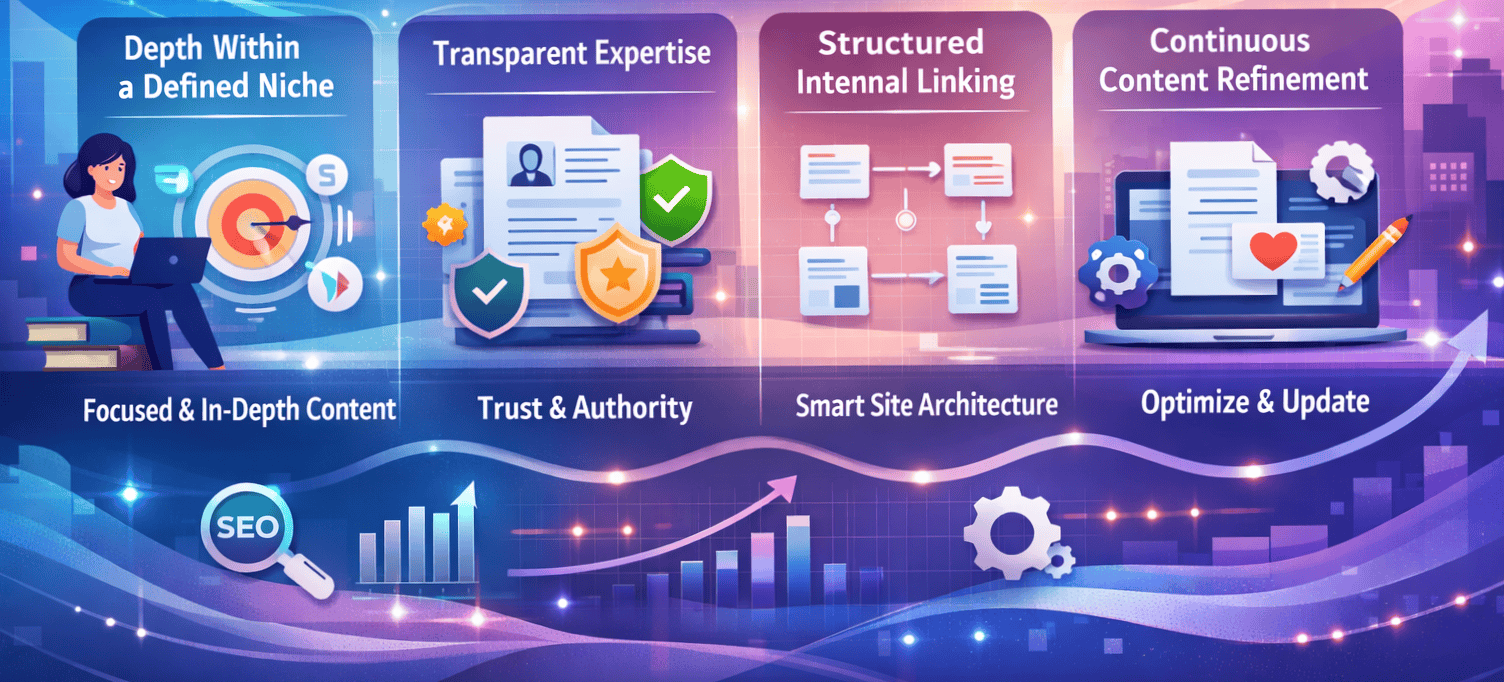
A sustainable strategy focuses on:
- Depth within a defined niche
- Transparent expertise
- Structured internal linking
- Continuous content refinement
AI search will continue to adapt. Startups that invest early in authority, clarity, and user satisfaction will compound visibility over time.
Future-proof SEO is less about reacting to algorithm updates and more about building assets that remain valuable regardless of interface changes.
Conclusion: Building Authority in the AI Search Era
Search is shifting from page ranking to source selection.
AI systems no longer display results based solely on keyword alignment and link volume. They evaluate intent alignment, entity depth, behavioral satisfaction, and demonstrated expertise. Visibility increasingly depends on whether your brand is trusted enough to be cited inside generated answers.
Several priorities now define competitive advantage.
Context replaces keyword repetition.
Experience strengthens credibility.
Engagement validates relevance.
Structured data improves machine clarity.
Editorial oversight protects quality.
Marketers and startup founders must treat content as long-term infrastructure. Authority compounds when expertise is consistent, topical clusters are structured, and user needs are resolved without friction.
The opportunity remains significant. AI-driven search still requires high-quality sources. Brands that invest in clarity, accuracy, and intent alignment can secure durable visibility.
This is the moment to audit your existing content. Evaluate depth. Strengthen entity associations. Clarify authorship. Remove thin or redundant pages. Refine internal linking. Add structured markup where missing.
AI search will continue to evolve. The underlying principle will not. Systems reward content that helps users complete tasks efficiently and confidently.
Build resources that deserve to be referenced.
If your organic growth strategy depends on search, begin preparing now. The brands that adapt early will shape how AI answers are constructed in 2026 and beyond.